
Test choice
IELTS computer-based vs paper-based in 2026: paper is being withdrawn — what changes and what to book
IELTS moves to computer-only delivery from mid-2026, with Writing on Paper in some countries. The real differences, what stays the same and what to book now.
CD IELTS Prep Editorial Team · Published 26 August 2026 · Updated 1 October 2026 · 10 min read
Original, independent practice guidance. CD IELTS Prep is not an official IELTS provider; confirm current booking and test-day requirements with your test centre.
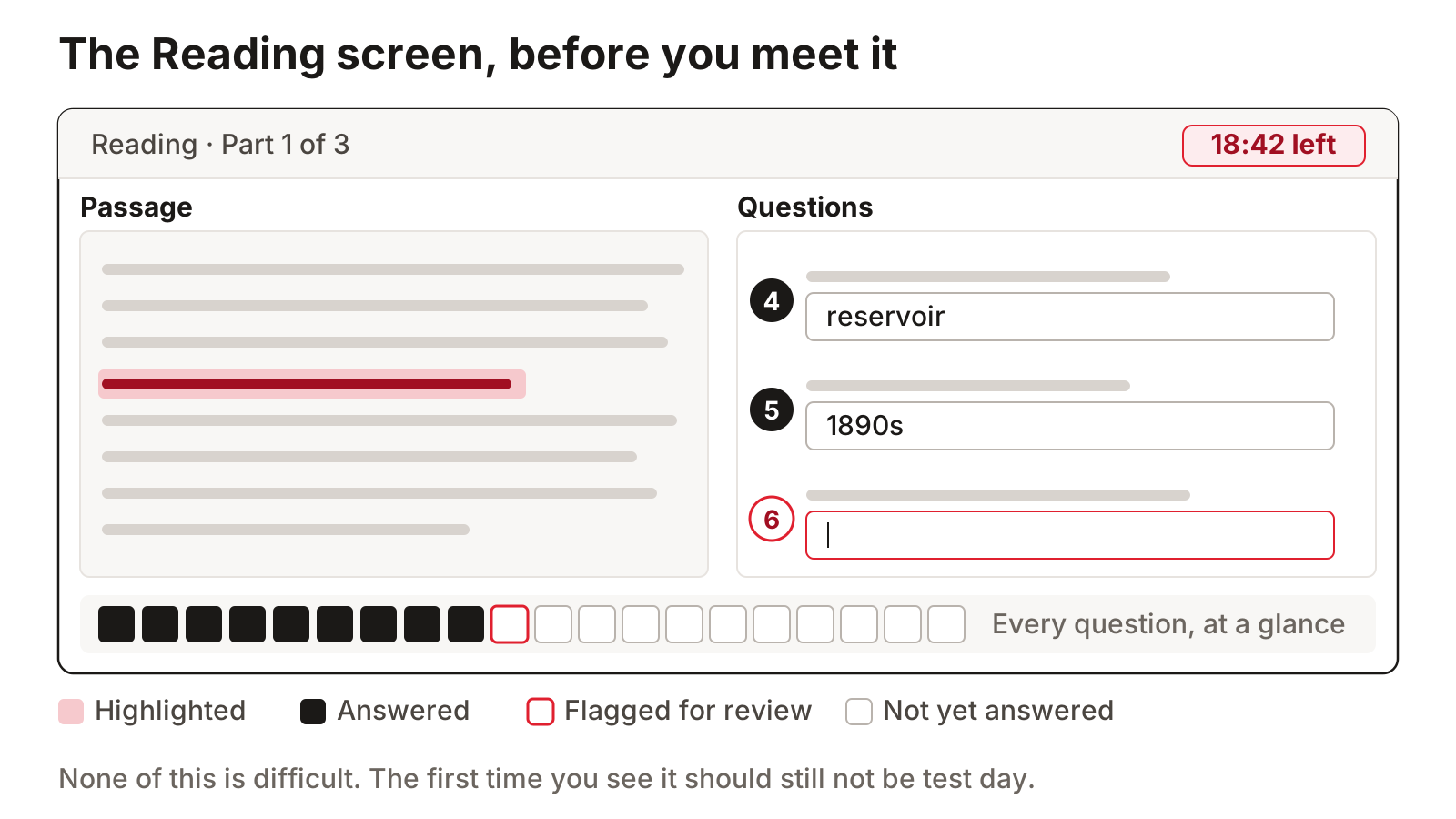
Short answer: from mid-2026 the choice is going away. On 5 March 2026 the IELTS partners announced that IELTS will no longer be offered as a paper-based test and that all IELTS tests will be delivered on computer, with exact timelines varying by market. In selected countries a new option, Writing on Paper, lets you take Listening and Reading on screen and handwrite your Writing answers. The IELTS partners say the change does not alter the skills assessed, the test construct or the way institutions should interpret your result.
So the old question, computer or paper, has become two narrower ones. Has paper already ended in your country, or are you looking at one of its last sittings? And if Writing on Paper is offered where you test, do you want to type your Writing or handwrite it? This guide answers both, keeps the honest comparison for anyone still holding a paper date or paper-trained habits, and ends with what to do now.
What IELTS announced in March 2026
- Paper ends from mid-2026. IELTS will no longer be offered as a paper-based test, and all IELTS tests will be delivered on computer. Exact timelines vary by market, so paper dates may still appear in some countries for a while.
- Writing on Paper arrives in selected countries. You take the test on computer but are given an IELTS Writing Answer Sheet and a pen for the Writing component. It covers IELTS Academic and General Training, but not IELTS for UKVI.
- The UK visa test goes fully digital. The Secure English Language Test (SELT) for UK Visas and Immigration purposes will only be available in the fully digital format.
- Existing paper results are unaffected. They remain valid until the end of the recommended two-year period.
- One Skill Retake extends to Writing on Paper, but the retake must be taken in the same delivery mode as the original test.
- Access arrangements continue, including large print, braille, lip-reading support for hearing-impaired candidates, and One Skill Retake for candidates with access arrangements.
IELTS computer-based vs paper-based vs Writing on Paper
The table sets the three test-centre options side by side. The paper column matters only if your country still lists paper dates, or if you have been practising on paper-format material, which is where most of the habits worth changing come from.
| What differs | Paper-based (being withdrawn) | IELTS on computer | Computer with Writing on Paper |
|---|---|---|---|
| Availability | Ending from mid-2026; timing varies by country | The standard mode as paper is withdrawn | Selected countries from mid-2026; not for IELTS for UKVI |
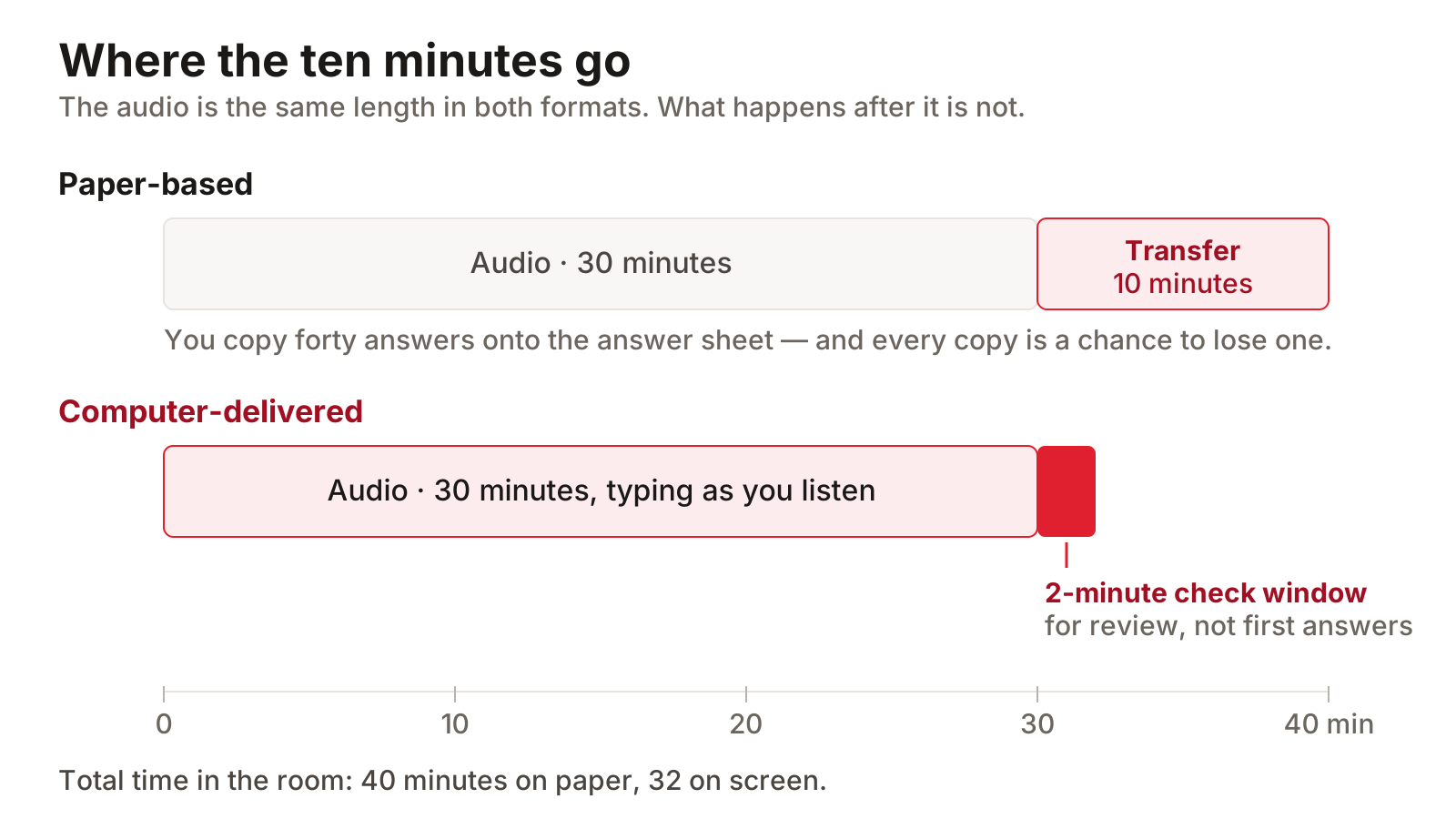
| Listening | Answers noted on the question paper, then 10 minutes to transfer them to the answer sheet | Answers typed as you listen; 2 minutes to review at the end, no transfer time | Same as IELTS on computer |
| Reading | Answers go on the answer sheet within the 60 minutes; annotate the booklet freely | Passage and questions side by side; highlight and add notes on screen | Same as IELTS on computer |
| Writing | Handwritten; you count your own words | Typed; word count shown on screen; edit, copy and paste within your answer | Tasks shown on screen; answers handwritten in pen on an IELTS Writing Answer Sheet |
| Speaking | Face to face with an IELTS examiner | Face to face with an IELTS examiner | Face to face with an IELTS examiner |
| Results | Within 13 days (7 days in India) | 1–5 days; most within 2 | Within 5 days |
| One Skill Retake | Not available: it requires an original IELTS on computer test | Available where the centre offers it, within 60 days | Available; a Writing retake must be handwritten too |
What Writing on Paper actually means
Writing on Paper is not a return to the paper test. Everything except your Writing answers stays on the computer: Listening and Reading are on screen, the Writing tasks themselves appear on screen, and Speaking is a face-to-face interview with an examiner. The one change is that you are handed an IELTS Writing Answer Sheet and a pen, and you write your Task 1 and Task 2 answers by hand.
- Same Writing test: the task types, scoring and 60-minute time allocation are the same whether you type or handwrite.
- Both modules: it is offered for IELTS Academic and IELTS General Training, in selected countries, from mid-2026.
- Not for UK visas: Writing on Paper is not available for IELTS for UKVI.
- Invisible on your certificate: the Test Report Form does not say that you chose Writing on Paper, and results arrive within five days.
- Retakes stay in mode: if you use One Skill Retake for Writing, you must retake it in the same delivery mode you chose originally.
IELTS reports a field trial in November 2025 in which participants took Writing on Paper within 90 days of a previous paper-based test, and says scores were comparable across formats, both overall and within each score band. Availability is decided country by country, so the only reliable check is the booking page for the centre you plan to use.
What does not change
- The skills assessed and the test construct: the same four skills, the same sections and the same question types.
- How institutions should read your result: the IELTS partners state the move to computer does not change how results should be interpreted, so a band score means what it meant before.
- Writing assessment: examiners mark typed and handwritten answers against the same criteria.
- Speaking: still a live, face-to-face interview with an IELTS examiner in every test-centre mode.
- Your existing result: a paper Test Report Form stays valid for the rest of its recommended two-year period.
Who should type their Writing
If Writing on Paper is offered where you test, this is now the one real format decision. It is about speed and editing, not difficulty: the scoring is the same either way.
- You type faster than you handwrite, measured rather than assumed (the test below takes ten minutes).
- You restructure as you go. On screen you can delete, move and copy text within your answer, and the word count is always visible.
- Your handwriting is hard to read. Typed answers remove legibility as a risk entirely.
- You are taking IELTS for UKVI, where Writing on Paper is not available, or your country does not offer it.
Who should choose Writing on Paper, where it is offered
- You handwrite faster than you type, or typing under time pressure produces runs of typos, each of which is marked as a spelling error.
- You plan carefully and draft in one pass, so the on-screen editing tools would save you little time.
- You have written months of timed essays by hand and test day is close. Switching medium in the final fortnight buys risk for no reward.
What you can no longer choose is paper Listening and Reading. Even with Writing on Paper, those two sections are on screen, so preferring to underline in a printed booklet is no longer a reason to pick a format. Train the on-screen highlighter instead.
Work out whether typing is your real constraint
Everyone guesses at this and almost nobody measures it. Time yourself typing 250 words of your own prose — composing, not copying — and work out the rate. At 25 words a minute a Task 2 answer takes ten of its forty minutes, leaving thirty for planning and checking. At 15 words a minute it takes nearly seventeen, and adding Task 1's 150 words means you are typing for roughly twenty-seven of the hour. At 10 words a minute you are typing for forty of the sixty, and the format has become the exam. Run the same measurement with a pen before you conclude anything: a fair number of candidates discover they handwrite no faster than they type.
Moving from paper practice to the screen? Build a navigator sweep, a typing check and a review routine that hold up under a live timer.
Make practice transfer to screenWhat to do now
- Check your country before you plan anything. Open the IELTS booking page, choose your city and the dates you need, and see which delivery modes are listed. Paper may already be gone where you are, or down to its last sittings.
- Already holding a paper result? Nothing happens to it. It stays valid until the end of the recommended two-year period.
- Booking IELTS for UKVI? Plan to type: the UK visa test is fully digital and Writing on Paper is not offered for it.
- Want One Skill Retake as a safety net? It needs an original IELTS on computer test at a centre that offers it, must be sat within 60 days, and is allowed once per test. Confirm that the organisation you are applying to accepts it before relying on it.
- Move your Listening and Reading practice onto a screen now: typing answers while the audio plays, a 2-minute review instead of a 10-minute transfer, highlighting on screen, and using the question navigator to find gaps.
- If you book Writing on Paper, practise Writing by hand against a 60-minute clock and everything else on screen.
The mistake most candidates make
Preparing for a computer test on printed papers. Plenty of practice material in circulation was written for the paper test, with an answer sheet and transfer time built in. The interface is a skill: single-play audio while you type, the 2-minute review instead of the 10-minute transfer, the question navigator, the on-screen highlighter. None of it is hard, but the first time you meet it should not be test day.
Common questions
Is IELTS still available on paper in 2026?
Only where the phase-out has not reached yet. IELTS announced on 5 March 2026 that from mid-2026 it will no longer be offered as a paper-based test and that all tests will be delivered on computer, with exact timelines varying by market. Check the booking page for your country. If paper has gone and you prefer handwriting, look for the Writing on Paper option, offered in selected countries.
Is IELTS computer-based from home?
No. IELTS on computer is taken at an official IELTS test centre, on a centre computer, with the Speaking test face to face with an examiner. The at-home option is a separate format, IELTS Online: IELTS Academic only, offered in some countries, for candidates aged 18 and over, with Speaking by video call and results in 6–8 days. IELTS Online is not accepted for immigration or professional registration, its Test Report Form shows that you tested online, and you should confirm your institution accepts it before booking. Tests for UK visas must be taken at an official test centre.
IELTS paper-based or computer-based: which is better?
Neither is easier: the content and marking are the same, and Speaking is a live examiner in both. Computer delivery has practical advantages — results in 1–5 days instead of up to 13, access to One Skill Retake, and a question navigator that shows what you have not answered — and from mid-2026 it is the standard anyway. If you prefer handwriting, the real choice is whether to take Writing on Paper where it is offered.
What is the difference between IELTS on computer and on paper?
The medium, not the test. On computer you type Listening answers as you hear them and get 2 minutes to review at the end, instead of 10 minutes to transfer answers to a sheet; you read passages on screen with highlighting and notes; you type Writing with a live word count; and results arrive in 1–5 days rather than within 13. The skills assessed, the question types and the band scale are the same.
Will my Test Report Form show that I chose Writing on Paper?
No. The Test Report Form does not specify that you chose Writing on Paper, and the IELTS partners state that the delivery change does not alter how institutions should interpret results.
Is the Listening harder on computer?
It is different rather than harder. You type answers while listening instead of copying them later, so you lose the 10-minute transfer but also lose transfer errors. The 2-minute review window is for checking, not for first-time answering.
Can I take notes during the computer test?
Yes. You can write on a notes sheet during Listening, highlight and add notes on screen in Reading, and in Speaking Part 2 the examiner gives you a pencil and paper for your one minute of preparation.
Do spelling mistakes cost more on computer?
They cost exactly the same: a misspelt Listening or Reading answer is wrong in any format, and a typing slip is marked as a spelling error. Read each typed answer back before you move on — the habit matters more on screen than it feels like it should.
My paper IELTS result is from 2025. Do I need to retake?
Not because of this change. Paper results are unaffected and remain valid until the end of the recommended two-year period. How recent a result an organisation accepts is its own rule, so check its validity window against your application date.
The surest way to prepare for a computer-delivered test is to sit one. Try a full mock on a computer-delivered layout — question navigator, highlighter, single-play audio and the 2-minute review.
Take a free CD mock test