
IELTS by destination
IELTS preparation for Germany
Germany draws international students with English-taught bachelor's and master's degrees, and for most of them the English proof a university asks for is IELTS Academic. There is no national score to hit — each programme sets its own bar, usually stated as a CEFR level, and the variant and band you need depend on how your course is taught, not on the visa itself.
- Variant for study routes
- AC
- How Germany reads bands
- CEFR
- Full timed mocks here
- L·R·W
- To start practising
- $0
Germany · 01
Which IELTS do you need for Germany?
For the international students Germany attracts most — those on English-taught bachelor's and master's degrees — the English evidence a university asks for is IELTS Academic. Academic and General Training share identical Listening and Speaking papers, but Reading and Writing Task 1 differ, so practise the Academic variant that admissions actually reads.
If your programme is taught in German, IELTS is not the test you need at all: those courses ask for German-language proof such as TestDaF or the DSH exam. The DAAD programme database lists what each course accepts, so confirm your specific programme there and on the university's own page before booking anything.
Germany · 02
How Germany reads your band: CEFR levels
German universities usually express their English requirement as a level on the Common European Framework of Reference — most often B2 or C1 — rather than as an IELTS band. Each CEFR level maps to a range of IELTS bands through the IELTS partners' published alignment, so a course that asks for C1 is asking for a higher band than one that accepts B2.
The mapping is a guide, not a single fixed number: a programme is free to set its own band within a CEFR level, and some name both a level and an exact band. Read the requirement on the programme page, match it to the band table below, and target that band in practice.
Germany · 03
Study route or work route?
IELTS matters for the study route — admission to an English-taught degree — and rarely anywhere else. For the EU Blue Card and other skilled-work routes, what qualifies you is a recognised qualification, a concrete job offer and a salary at or above the threshold; English ability is something your employer judges for the role, not a language certificate you file with the immigration authority.
So book IELTS for Germany when a university or programme names it, and not on the assumption that the work visa requires it. If an employer or a specific professional body does ask for proof of English, they will state the test and level they want — follow that, rather than a general rule.
Germany · 04
Practising for the computer-delivered test
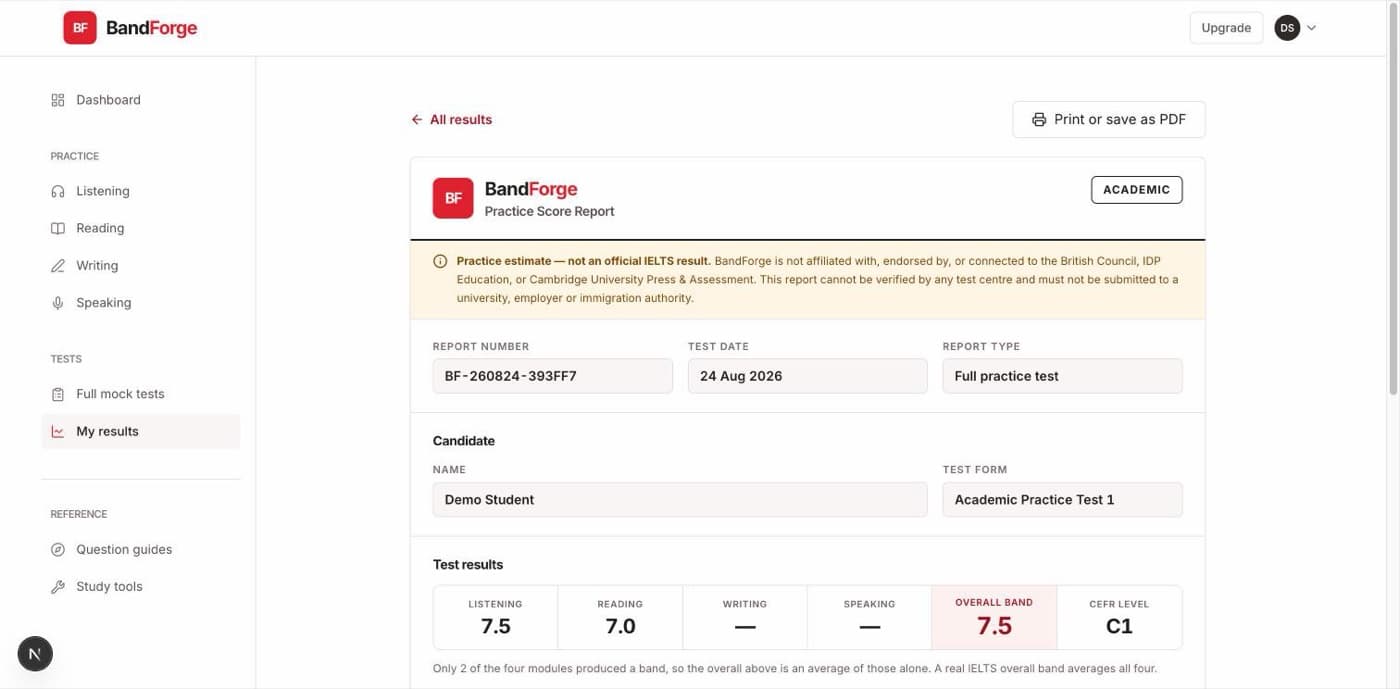
German test centres widely offer computer-delivered IELTS, and its interface — one-play Listening audio with a short review window, on-screen highlighting, and typed Writing with a live word count — is exactly what CD IELTS Prep reproduces. Sitting full timed mocks in the same software removes the format as a variable, so test day tests your English rather than your ability to learn a new tool under pressure.
Writing is the module study-bound candidates most often need to lift, since C1-level programmes sit near band 7.0. The samples library shows one question answered at band 6.5, 7.5 and 9 with the differences annotated, and the writing checker returns a structured four-criterion practice estimate on your own answers, so each session ends with something to act on.
The numbers
Germany requirements at a glance
The official mappings and minimums, on the page — verify your exact stream on the official source it names.
What evidence each route needs
The stable structure — which language proof each route asks for, and who sets it. No route carries a national IELTS number; the requirement always lives with the university or the employer.
| Route | Typical language evidence | Who sets the requirement |
|---|---|---|
| English-taught bachelor's or master's | IELTS Academic, or an accepted equivalent such as TOEFL | The individual university / programme |
| German-taught degree programme | German proof — TestDaF or DSH — not IELTS | The university; DAAD lists what each course accepts |
| Bilingual or mixed-language programme | English via IELTS Academic, plus German at the stated level | The programme page |
| Student visa / residence permit | No separate IELTS minimum — it follows the admission letter | The admitting university, not the consulate |
| EU Blue Card / skilled work | A qualifying job offer and salary; English judged by the employer | Federal immigration rules and the employer |
Germany sets no national IELTS band — the qualifying requirement is always your programme's admission letter. Confirm the exact band and the list of accepted tests on the university's programme page, or via the DAAD programme database, before you book.
IELTS bands and CEFR levels
German admissions state English requirements in CEFR levels; this is the IELTS partners' published alignment between bands and the CEFR.
| CEFR level | IELTS band range |
|---|---|
| C2 — Proficient | 8.5 - 9.0 |
| C1 — Advanced | 7.0 - 8.0 |
| B2 — Upper intermediate | 5.5 - 6.5 |
| B1 — Intermediate | 4.0 - 5.0 |
A course asking for C1 typically wants roughly band 7.0 or above; one asking B2 usually accepts 5.5-6.5. Each university fixes its own band within the level, so treat this as a guide and verify the figure on the programme page.
The preparation path
How to prepare for Germany from here
Three steps, in the same on-screen format you will face at the test centre.
Pick your variant
Academic or General Training — your route decides it, and Reading and Writing Task 1 differ between them.
See the testsSit a timed baseline mock
One full paper in the real computer-delivered interface shows your true starting band and where the marks go.
Start freeDrill what costs you marks
Question-type drills, writing checks and the study plan turn your weakest areas into your daily practice.
Browse practiceFree tools
Built for Germany candidates
No account needed — each one answers a question this destination's candidates actually ask.
Academic mock tests
Full timed Academic practice in the computer-delivered interface.
Open the toolBand 9 writing samples
The same question answered at band 6.5, 7.5 and 9, annotated.
Open the toolWriting checker
Four-criterion practice feedback on your own essay.
Open the toolIELTS score converter
See how your band lines up with the other tests programmes list.
Open the toolWhere to start
Pick the skill holding your band back
Each path is a routine you can repeat every week, and it starts on the page where the practice happens.

“I lose marks to spelling and distractors”
A weekly Listening routine
- 1Sit one timed Listening section with the audio played once, as on test day.
- 2Review every wrong answer: spelling, plurals, and the distractor you fell for.
- 3Drill the question type you lose most, then sit another full section.
Questions candidates ask
Frequently asked questions
Do I need IELTS to study in Germany?
Only for English-taught programmes, which typically ask for IELTS Academic. German-taught courses want German proof such as TestDaF or DSH instead. Confirm what your specific programme accepts on the university's page or in the DAAD programme database.
Is IELTS Academic or General Training needed for Germany?
Academic. University admission and professional registration read IELTS Academic; General Training is built for work and migration routes and is not what German programmes ask for.
Is there an IELTS score requirement for the German student visa?
No. The student visa and residence permit have no national IELTS minimum — they follow your university's admission letter, and the university sets the English requirement. Meet the programme's bar and the visa's language question answers itself.
Do I need IELTS for the EU Blue Card?
No. The Blue Card qualifies on a recognised qualification, a job offer and a salary at or above the threshold; English is judged by the employer for the role, not certified to immigration. Take IELTS only if a specific employer or body asks for it.
What IELTS band do German universities ask for?
It varies by programme and is usually stated as a CEFR level — commonly B2 or C1 — which maps to a band range. A C1 course generally wants around band 7.0; confirm the exact band on the programme page before you book.
Does Germany accept TOEFL instead of IELTS?
Many English-taught programmes accept either IELTS Academic or TOEFL, and the programme page lists which tests it recognises. Check that list before booking so you sit a test your course accepts.

Your next practice session
Sit your next practice test the way you will sit the real one
One free practice item in every module, instant marking, and new tests every week. No card required.